Showing posts with label LawyersinDelhi. Show all posts

Thursday, November 21, 2019

Corporate Law is not only About Drafting Agreements?

The general perception of corporate law is that it involves drafting various legal agreements such as joint venture agreements, shareholders agreements, licensing agreements and government contracts. Since this work depicts a major portion of the practice of corporate law, it leads one to think that this is what corporate lawyers must be doing. This assertion is partly correct and partly incorrect. It is incorrect because corporate law is much more than only drafting agreements. It is an entire field of law that governs corporations and ensures that they run their business smoothly. This article highlights other aspects that come under corporate law and puts forward the case that corporate law goes beyond merely drafting agreements.
CORPORATE LAW- AN OVERVIEW
In a general sense, corporate law governs the working of corporations and their businesses. Corporate lawyers deal in a host of areas such as setting up a corporation, organizing its structure, ensuring compliance with relevant laws and regulations, raising capital, restructuring liabilities and protecting intellectual property. In addition to this, they also advise their Read More 

Thursday, October 17, 2019

Case Study On Contract Arising Out Of A General Offer


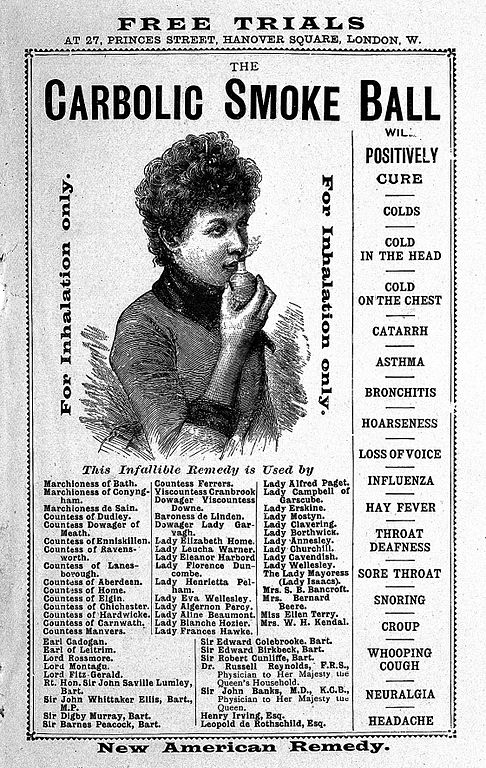
Carlill v Carbolic Smoke Ball Company [1892] EWCA Civ 1 is one of the most leading matters relating to the contract arising out of a general offer law of contracts under common law. This case is known for both its academic importance as well as its contribution to the expansion of the laws regarding unilateral contracts.

The contract arising out of a general offer: Carlill v. Carbolic Smoke Ball Co

In this matter, the defendants had advertised their product Carboli Smoke Ball for a preventive remedy against influenza and in the advertisement, they offered to pay £100 as reward towards anybody who contacted influenza, cold or any other disease caused after having used the product in the set manner. The petitioner depending on the advertisement bought a Smoke Ball and utilized the same as per the directions, nevertheless, she still caught influenza. Therefore, she charged the defendants to claim the reward of £100. It was stated that this being a general offer furnished to all the world had developed into a contract with the petitioner by her action of performance of the essential conditions and therefore accepting the offer. Hence, the petitioner was held eligible to Read More 

Concept of White-Collar Crime

Almost all societies have certain norms, beliefs, customs and traditions which are implicitly accepted by its members as conducive to their well being and healthy development
White-collar crime can be referred to as the crimes which are done as a motive of financial benefit in business and there is an absence of any violence. Such crimes are committed by the people who are highly educated and belong to the high-class of society.
It can be defined as the crimes that are committed by the highly professional and reputed people. These people, who are committing such crimes, are educated and intelligent people, who are well researched and have a better knowledge of technology and other resources. We will usually find these white-collar crimes happening in a big reputed organization which are involved in various activities. When we talk about professional groups the very obvious fields that pop into the mind are the medical, legal, engineers, trade, etc.
Such crimes deal with such high profile fields. White-collar crime majorly can be differentiated by the class of the people-crimes committed by the low class or uneducated group of people are regarded as ordinary crimes whereas the crime committed by educated or high-class people are referred to as white-collar crimes. These people execute crimes in a very well planned manner so that they can escape and maintain the dignity and self-respect that they have in society.
Let us first understand as to who first introduced the concept of white-collar crime and what he meant by the concept of white-collar crimes:
American sociologist Mr Edwin Sutherland in the year 1949 defined white-collar crimes as ‘‘approximately as a crime committed by a Read More 

Wednesday, October 16, 2019

Intellectual Property and Startups: Correlation and Impact


In the present aggressive condition, advancement is the pillar for each business that prompts the improvement of protected innovation. Recognizing, creating, and utilizing development gives a focused edge and helps in long haul accomplishment of the organization. Protected innovation isn't constrained to innovation organizations, yet is profitable for each business which puts enormous aggregates in innovative work for making indigenous items and administrations.
An organization ought to be proactive in executing IP answers to distinguishing novel developments and increment incomes. A well-characterized IP objective can bring about accomplishing business targets and help position the business as a pioneer in the commercial centre. With the development in business incomes, the IP procedure can incorporate ensuring the novel parts of the advantages and encourage advancements to investigate new geologies.
An organization must assess its current licensed innovation to decide if it is by business goals. This encourages the organization to recognize better approaches to use protected innovation through authorizing openings. Fruitful organizations must search for new roads to extend their item contributions, increment their business income, and attack into new advertises.
An association's patent portfolio is imperative for its future accomplishment along with its different protected innovation resources as Read More 

The Importance of Intellectual Property Rights to Businesses


‘Intellectual Property’ extensively refers to the fabrication of a rational human mind. Intellectual Property Rights or Intangible property rights rifely refer to those rights awarded to a person on such creation. It is a hamper consisting of many rights. A business organization is an economic system where goods or services are exchanged for money.
The world economy has witnessed unfathomable transformation due to the changing conditions which help in the determination of the wealth of nations. These changes have led to an increase in commercial flow whereby the interest in Intellectual Property has increased and the activities related to their protection. The technological advances in areas such as computing, chemistry, interalia have led to the demand for the creation of new forms of protection and the acclimation of existing ones.
Intellectual Property plays a pre-eminent role in any business entity and lies at the core of it. A business entity should be driven in identifying and implementing IP solutions which will, in turn, help the company reach new heights of success. The myth that only lawyers can handle or deal with IP assets is a hoax because in order for a company to position itself as a leader in the marketplace it is of utmost importance that its IP assets are managed and strategized as required. Development of skills and competence to manage intellectual property assets has become mandatory for sustainable competitiveness. Management professionals are best suited to manage and commercialize these assets in order to generate revenue.
Knowledge has become a crucial factor in differentiating enterprises from their competitors. 21st century has been called the century of knowledge. As Henry Ford has aptly stated that the only real security a man has in today’s world is the reservoir of knowledge. However, it is of Read More 

Tuesday, October 15, 2019

Different Types Of Website Policies


A website contract is crucial for any business to keep the business people connected with the users. There are various types of agreements such as Website terms & conditions and privacy policies.
Each website's T&C's and privacy policies are different and, need not be the same. The right to decide the policies rests with the website owner. The policies must be adaptable, easy to understand and, acceptable by law.
Terms and conditions for a website act as a basis for a website, before getting into a final agreement with the user. They help in imparting the knowledge of the rules and regulations and business risks involved. Sometimes, the user may be required to sign a disclosure form.
There are two approaches to make users agree to the terms and conditions. These are Browse wrap and Clickwrap, and the second is preferred over the first. This is due to the confirmation by the user that he has agreed to the specified terms and conditions. The latter does not provide any Read More 

Thursday, October 10, 2019

Prevention Of Sexual Harassment Of Women At Work - Role Of CSR

In today's society, sexual harassment has unavoidably become a pressing social issue in the workplace. The recent #metoo movement has created a pressure that has forced many corporate companies to take dutiful action in this regard. The POSH Act was introduced to help employees learn how to anticipate, manage, and inform such cases of harassment. Every company aims to provide a secure working place for women, and this is well achieved by complying with the POSH policy.

Sexual Harassment

Any conduct relating to physical, vocal, emotional that harms the other person is regarded as harassment, and not encouraged in the POSH policy. In such a case, strict action is taken on the person who has committed the abuse.
Different kind of sexual disturbances includes sexual favours demanded as a threat to promotion or employment of a person, sharing exposed images, sending underrated jokes, molestation, interference with the personal lives of women, abuses related to the appearance of a person.

Internal Complaint Committee (ICC)

It is advised to form a committee in every organisation to discuss these harassment issues. The panel must comprise of four members out of which two must compulsorily be women, and must be approachable. All the complaints must be duly recorded, and appropriate action is required to be taken after a Read More 

Thursday, September 26, 2019

Employment And Labour Laws For Women

In the current era, women have grown equal to men and gone are those days when women were limited within four walls. Women empowerment is increasing nowadays. Women are now contributing as the major workforce in India, and it is imperative to safeguard women at the workplace. Working women are increasing in the agriculture segment, being 90 million out of 409 million workforces, which constitutes 87% as workers and cultivators.
The main reason behind preferring males over female workers is costing, which culminates from paying female workers higher than males. The wage difference is a common problem encountered by women in this demanding market.
To overcome these differences in terms of gender, and to provide more protection to women, companies have enforced several laws to make them feel encouraged. Women need to be aware of these laws to protect them in their job.

The Minimum Wage Act

The government has imposed this act, which fixes a minimum amount of money to be paid to the worker. The wages have to be paid according to the type of job irrespective of the gender. This can vary from state to state and it is decided by the government of India.
In cities, on an average wage paid to females is only 75% of that given to males, while in rural areas females are paid 58% of Read More 

Tuesday, September 24, 2019

Incorporation: What you need to know


Along with certain risks, there come many advantages with incorporating a company, business, trade or commerce. The structured procedure of incorporation results in creating a legal entity that is referred to as ‘corporation’. Incorporation allows a company to become a legal person in the eyes of law and separates it from its incorporators from the date of incorporation. Additionally, incorporation provides the corporation for personal assets protection, tax benefits. opportunities for raising capital and much more.
Incorporation, in literal terms, means formation. Incorporation of a company refers to a legal process for forming a corporate and separate legal entity. The formed corporations are then, identified with terms like “Inc” or “Ltd”. From the date of the incorporation mentioned in the certificate of incorporation, the corporation is formed as a body corporate by the name provided in its Memorandum of Association and is capable of exercising all its Read More 

Monday, September 23, 2019

Trademark And Types


Trademarks are of different sorts; item checks, administration marks, aggregate imprints, accreditation marks, shape marks, and so on. The motivation behind the logo is the equivalent, regardless of its sort. It enables the purchasers to recognize the wellspring of the item/administration and guarantees the nature of the item or administration. The fundamental motivation behind every one of these trademarks is to enable clients to distinguish inception and quality of the hidden objects or administrations.

Product Mark

Item mark is an imprint that is utilized on a decent or an item as opposed to the administration. This sort of trademark is used to perceive the root of the issue, aides in keeping up the notoriety of the business. Trademark applications recorded under trademark class 1-34 could be named as an item mark, as they speak to products.

Service Mark

Administration imprint is like the item mark, yet an administration imprint is utilized to speak to an administration instead of an item. The primary motivation behind the administration imprint is Read More 

Wednesday, September 11, 2019

Regulation of Cryptocurrency

The advent of Cryptocurrency is a revolution in the domain of money. The popularity it gained and the issue raised about the legality and illegality of cryptocurrency are trending matters of discussion among people. In India, this digital currency was accepted; however, the plethora of confusion was the outcome. Thus, the government of India decided to make the regulation of digital currency, which is undoubtedly a very different and much-required step.
Right from the beginning, Cryptocurrency is eminent as a digital currency used in online transactions. They are completely distinct from the traditional currency, and the most remarkable thing is that no authority controls it. It led to making cryptocurrency attraction of many investors in India. As the usage of cryptocurrency increased, almost everyone witnessed the cons of using cryptocurrency simultaneously. Some of the issues that arise are a surge in corruption, misuse of money, money laundering and more.
To stop this, the governing bodies and other concerned authorities decided to ban and regulate the usage of cryptocurrency in India. The government has decided to impose severe punishment on the people who are still using cryptocurrency. According to the draft of "Banning of Cryptocurrency and Regulation of Official Digital Currency Bill, 2019", the usage of cryptocurrency in India is illegal, and anyone caught using, holding, selling, dealing or Read More 

Tuesday, September 3, 2019

Is Technology An Intellectual Property?

The demanding world of ours runs on the competitiveness between the different firms and the economic health of the various nations. Also, both these things depend on the ability to commercialize various ideas and innovate different technologies. This is measured concerning the above entities as it helps a nation or any individual gain economic benefits based on scientific and technological innovations.
Thus, technology has also become intellectual property. The intellectual property rights include patents and copyrights, which are under a company or an individual. This is done by firms to protect their investments in the technological arena. Even the government bodies use it as intellectual property to encourage industrial growth and economic development of a country.
Intellectual Property right on technology basically grants an innovator with a temporary monopoly on the usage of the innovation. In this way, even the investors feel secure and can see a proper gain in the near future. Basically, the rights help the innovator as a sudden imitation of the invention or the product is not allowed. If that happens, the innovator’s return would decrease and the investors will not be able to make any profit. At the same time, it would also decrease the incentive to innovate.
The Intellectual property rights on technology not Read More 

Sunday, August 25, 2019

GST: An Overview And Analysis


What is GST?
GST, short for the Goods and Services Tax, is a recently launch value-added tax passed by the government of India on 29th March 2017. It came into effect on 1st July 2017, and since then it has replaced all indirect smaller taxes in the country. It applies to goods and services used domestically. GST is paid by the consumers indirectly to the government (through the respective businesses).

GST serves as revenue for the government and has eliminated most state taxes. It is regarded as a "comprehensive, destination-based, multi-staged tax" since its imposed at various stages of production, though it is refunded to all but the final customer who buys it.

Like all taxes, GST too is governed by specific rules and regulations which are controlled by the GST Council (GSTC). GSTC was started by the Good and Services Act, which consists of Union Finance Ministers and Finance Ministers of all the states. GST has received a ton of criticism since it's implementation, and debates are still on about its pros and cons. Its main motive was to replace various indirect taxes and redesign the nation's economy in a more planned manner.

What Effect Did GST have on the market?
There have been numerous speculation on what impact GST had on the economy and market of the country. Here's a list of what changes GST brought with it, based on facts:

GST has reduced tax burden from the producers and thus encourages more and cheaper production. The previous taxation structure controlled by an infinite number of clauses prohibited the Read More


FSSAI - New rules to curb misleading advertisements


The Food Safety and Standards (FSSAI) (Advertising and Claims) Regulations, which were implemented from 1 July, are supposed to make celebrities, who subscribe to food products, more answerable. The laws will also initiate fairness in claims made by packaged food business house.
The Food Safety and Standards Authority of India (FSSAI) is a statutory body established under the Food Safety and Standards Act, 2006. The Advertising Standards Council of India (ASCI) is a self-regulatory body that broadcasts responsible advertising. These two authorities have come together against ambiguous advertisements in the food and beverages section and have signed Memorandum of Understanding (MOU) for the same.
Minister of Information and Broadcasting said in the Lok Sabha that the regulations are the intention to establish fairness in claims & advertisement of food products and make food business answerable for such claims & advertisements. 
The regulation clearly states that any person including third-party who advertises; or a part of the broadcasting of any misleading advertisement not in accordance with these regulations; would be punishable as per Section 53 of the Food Safety and Standards Act, 2006.
The Section 53 of the Food Safety and Standards Act, 2006, identifies that any person who broadcasts or a party to the broadcast of an advertisement, which deceitfully describes any food or is likely to be deceptive regarding the nature, substance, quality of any food or gives erroneous guarantee, will be liable to a penalty of maximum of Rs.10 lakhs.
As per the Department of Consumer Affairs, there is no allocation in the Consumer Protection Act 1986 to summon celebrities endorsing food products.
The purchaser can make a complaint against the prejudiced business practice in a consumer forum established under the Consumer Protection Act, 1986.
If the complaint is endorsed, the Consumer Forum can issue an order to the opposite party ordering him to remove the Read More


Monday, August 19, 2019

Significance of Law in Society


The law is significant for the general public for it fills in as a standard of lead for residents. It was likewise made to accommodate legitimate rules and request upon the conduct for all residents and to support the value on the three parts of the legislature. It keeps the general public running. Without law, there would be a disorder, and it would be survival of the fittest and every man for himself — not a perfect way of life for generally part. 

The law is significant because it goes about as a rule concerning what is acknowledged in the public arena. Without it, there would be clashes between social gatherings and networks. We must end them. The law takes into consideration simple reception to changes that happen in the general public. 

Society is a 'web-relationship,' and social change implies an adjustment in the arrangement of social relationship. There is social relationship comprehended as far as standard procedures with social connections and associations. In this way, the term, 'social change' is utilized to demonstrate alluring varieties in the social establishment, standard procedures, and social association. It incorporates adjustments in the structure and elements of the general public. Closer examination of the job of Law opposite social change drives us to recognize the direct and the roundabout parts of the duty of law. 

1. Law assumes a significant circuitous job concerning social change by molding an immediate effect on society. For instance: A law setting up is a mandatory instructive framework. 

2. Then again, law interfaces as a rule in a Read More 

Drugs and Cosmetics Act - Explained


The Government of India establishes an act which manages the import, produce and dealing out drugs in India. The central idea of the Act is to make certain that the drugs and cosmetics sold in India are safe, secure fruitful and conform to stipulate quality standards. The drugs Act was composed in 1940 in ensuing of recommendations of Chopra Committee established in 1930 by Indian Government. The drugs covered under the Drugs and Cosmetic Act wide varieties of remedial substances, distinctive and medical implementation.

Pursuant the Act cosmetic means any article intended to be rubbed, poured, sprinkled,  or sprayed on, introduced into, or otherwise applied to the human body or any part thereof for cleansing, beautifying, promoting attractiveness or altering the appearance, and includes any article intended for use as a component of cosmetic but does not  include soap. The Act has been additionally amended as Drugs (amendment) Act 1964 (13 of 1964) to include Ayurvedic and Unani drugs.
The Drugs Act, as validated in 1940, has since been amended many times and is now entitled as “The Drugs and Cosmetics Act, 1940”.
The drug laws were publicizing in 1945 December and imposition of these laws started in 1947. To meet the requirements of the Read More

Thursday, August 1, 2019

Confusion and How Law Students and Young Lawyers Fall Victim to it


It is exceptionally difficult to say which. This tiring round of score-keeping can remove you from your genuine objective, and leave you disappointed even though you continue buckling down on accomplishing one thing after another.

Accomplishment as a legal advisor is controlled by just a single thing: How great a legal counselor you are. How great an attorney you are is dictated by just a single thing: Whether you are ready to convey results to your customers?

When you have clarity about this, your reality will become all-good. You will quit pursuing a great many milestones, and pursue the one thing that truly matters to you. Curiously, when you do that, different markers of progress will be in all respects effectively accessible to you, in manners you can't even envision today.

My dad had a fantasy that I will go to IIT. I did not want to. Examining the building did not rouse me. I needed to be a legal counselor. In 2013, I drove a 4-hour corporate fund workshop at IIT Kharagpur, gone to by more than 300 understudies, for which every one of them had paid. I have taken workshops in different IITs and NITs the nation over as well.

I told my dad. Demonstrated to him the photos. I don't think he was convinced even at that. Nonetheless, my point is that on Read More 

Wednesday, July 3, 2019

Intellectual Property : Ownership Laws in India


When a work is made as a work for hire, the employer or other person for whom the work is prepared is considered the author and unless the party expressly agreed otherwise in a written instrument signed by them owns all of the rights comprised in the copyright. Determining whether a work was work for hire can be complicated in certain circumstances. Thus, here one thing that is important to know is that the owner of an IP is not always the same person who created it. To ensure effective ownership of IP developed in India, it is imperative that the companies understand the legal and practical aspects.
Who Owns The IP At The First Instance
As for the matter of fact, the IP ownership in India varies under different IP laws. The below mentioned are the various IP laws that govern the ownership of IP rights in India:
 a. Copyrights: the general rule for copyright works is Read More 

5 Must Know Intellectual Property Law Cases


1.      Novartis AG v. Union of India, (2007) 4 MLJ 1153
Facts
In 1997, Novartis, a Swiss based pharmaceutical giant filed an application to grant patent to an anticancer drug Glivec which is used to treat Chronic Myeloid Leukemia (CML) and Gastrointestinal Stromal Tumours (GIST) on the basis that it invented the beta crystalline salt form (imatinib mesylate) of the free base, imatinib.  It is a critical drug which is patented in about 35 countries of the world.
Till 2005 India was not into granting patent to pharmaceutical products and agrochemical products.  In the year 2005 India revised its patent law and started granting patents on pharmaceutical drugs. In 2006, the Madras Patent Office refused the patent application of Novartis for its drug Glivec stating that the said drug did not exhibit any major changes in therapeutic effectiveness over its pre-existing form, which was already patented outside India. The said decision was based on Section 3(d) of the Indian Patents (Amendment) Act, 2005 which provides  a known substance can only be patented if its Read More 

Uttarakhand High Court On Solitary Confinement


Solitary confinement requires an inmate to be restricted to one cell and has no contact or at least a very little contact, with other inmates. The critics call it inhumane, psychological torture that is hardly in line with rehabilitation. The reasons prisoners placed in isolation are many, it can be either to prevent them from fighting with another inmates or getting into fight with guards, like talking back to a guard or getting caught for doing something which they shouldn’t have been doing. Other times, prisoners are also thrown into the solitary confinement for not breaking any rules at all. Prisons have used solitary confinement as a tool to manage gangs, isolating people for simply talking to a suspected gang member. Prisons have also used solitary confinement as retribution for political activism. 
How was it created?
The concept of solitary confinement dates back to the late 18th and early 19thcentury when the British Government to create panic among the great freedom fighters built a jail which served as a colonial prison and was also known as “Kaala Pani or Black Water Jail” as the Read More 

This Constitution Day, let us thank lawyers | Lawyered.in

This Constitution Day, let us thank lawyers who have worked with integrity and justice in their minds, for the sake of making the society a...